Statewave Guide — Day 2: Unknown is better than wrong
The benchmark expected one route. The indexer found another. Only one of them was right
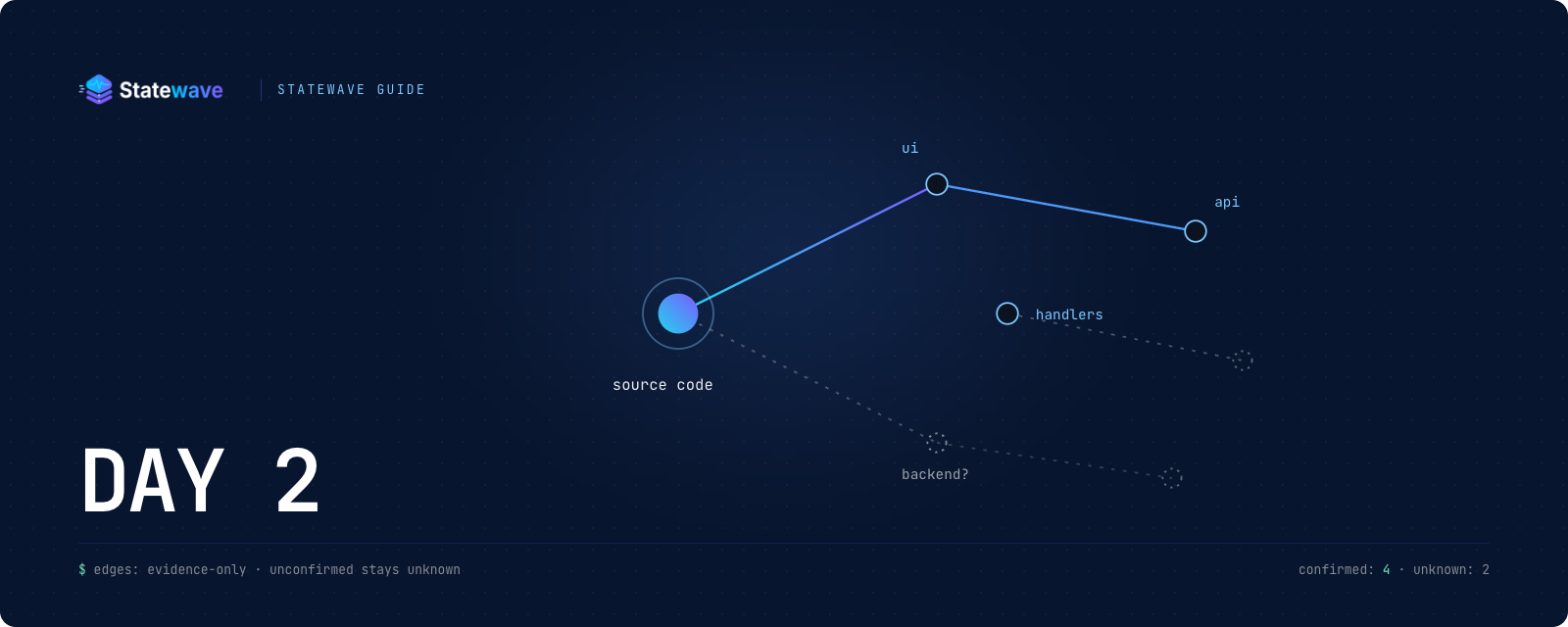
Built 26 Aug 2026 · written up 5 Oct 2026
Yesterday's question was:
Can we follow one real user action all the way from a button to the backend — without guessing?
Yes.
But getting there was a useful reminder that even your benchmark can lie to you.
The target looked simple:
New Client
    ↓
openCreateClient()
    ↓
NewClientDialog
    ↓
submitClient()
    ↓
clientService.create()
    ↓
POST /api/clients
Frontend to backend.
One connected application graph.
No docs.
No manually maintained knowledge base.
Easy, right? 😅
Our first quality run had other ideas.
invokes precision: 39%
API detection: 19%
calls_api: 0%
Beautiful.
At least the tests were honest. 😂
Then something more interesting happened.
We found what looked like an indexer bug.
The benchmark expected:
GET /clients
The indexer produced:
GET /api/clients
My first instinct was to normalize them.
Turns out that would have been wrong.
One adversarial fixture had another router with /clients whose mount point could not be determined.
Strip /api from the known endpoint and suddenly two different routes become the same thing.
Congratulations.
We've manufactured product knowledge.
So instead of fixing the indexer…
we fixed the benchmark.
That became another rule:
A benchmark isn't truth. It's an executable statement of what we currently believe truth is.
If the evidence proves the benchmark wrong, the benchmark loses.
We also introduced partial identities:
api:GET:?/clients
Meaning:
"I know this route exists. I do not know where it is mounted."
No guessing.
No helpful little inference quietly connecting it to the wrong backend handler.
After reconciliation:
API precision: 100% invokes: 100% / 100% uses_hook: 100% precision uses_service: 100% precision submits_to: 100% renders: 100% validates_with: 100% calls_api: 83% precision / 100% recall
Across the graph:
0 relationships without evidence. 0 invalid confidence values. 0 unsupported inferences pretending to be facts. 0 / 37 adversarial trap violations.
437 tests green.
We also discovered our previous "deterministic output" wasn't actually deterministic.
Same repository.
Different working directory.
Different graph.
😬
Eight working directories later:
one hash.
Fixed.
One of the most important files we added might actually be refusals.md.
A catalogue of things the system intentionally refuses to infer.
One real-world pattern would have generated dozens of fake API endpoints if we'd taken the obvious shortcut.
So we didn't.
That's increasingly becoming the philosophy behind Statewave Guide:
Missing knowledge is fixable. Wrong knowledge destroys trust.
So yes:
We can follow a real user action all the way to the backend without guessing.
Now comes the next problem.
We know increasingly well what happened.
But not necessarily what those facts mean to the user.
Statewave Guide — Day 2.
Next question:
Can a model add product meaning to this graph without being allowed to invent product truth?
This day in the repo: PR #2 · Previous: Day 1 — The DOM is not the product
Statewave Guide is built on Statewave — an open-source, self-hosted memory runtime for AI agents. Governance and provenance, not just retrieval. Apache 2.0.
→ statewave.ai · github.com/smaramwbc/statewave
Every post in this series: The Statewave Guide Journey Index
Originally published on the Statewave blog.